Beta version#
BETA TEST VERSION OF THIS ITEM
This online calculator is currently under heavy development. It may or it may NOT work correctly.
You CAN try to use it. You CAN even get the proper results.
However, please VERIFY all results on your own, as the level of completion of this item is NOT CONFIRMED.
Feel free to send any ideas and comments !
This online calculator is currently under heavy development. It may or it may NOT work correctly.
You CAN try to use it. You CAN even get the proper results.
However, please VERIFY all results on your own, as the level of completion of this item is NOT CONFIRMED.
Feel free to send any ideas and comments !
Periodic signals#
| Type of signal | Graph | Absolute mean value | Root Mean Square (RMS) | Waveform factor | Crest factor | Total Harmonic Distortion h1 | Total Harmonic Distortion h2 |
| Constant signal (DC) | 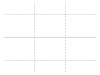 | Show source | Show source | Show source | Show source | Show source | Show source |
| Sine | 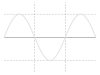 | Show source | Show source | Show source | Show source | Show source | Show source |
| Sine (full-wave rectification) | 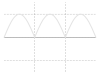 | Show source | Show source | Show source | Show source | Show source | Show source |
| Sine (half-wave rectification) | 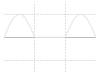 | Show source | Show source | Show source | Show source | Show source | Show source |
| Triangle symmetric | 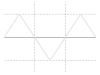 | Show source | Show source | Show source | Show source | Show source | Show source |
| Square symmetric (50% fill) | 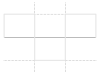 | Show source | Show source | Show source | Show source | Show source | Show source |
| Sawtooth | 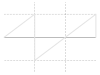 | Show source | Show source | Show source | Show source | Show source | Show source |
What is the meaning of each calculator field ?#
- Type of signal - the name of the signal, usually comes from the mathematical function that describes the signal (sinusoidal, square etc.).
- Graph - graphical representation of the signal in the form of a graph, the graph is normalized to one and shows one period.
- Absolute mean value - average value of the signal without sign (absolute value):
where:
- T - signal period (e.g. for sine signal),
- t - time,
- x(t) - signal value in time t.
- T - signal period (e.g. for sine signal),
- Root Mean Square (RMS) - The effective value of the alternating current is the value of the direct current, which in the course of time equal to the period of alternating current will cause the same thermal effect as the given AC signal (alternating current). It's statistical value defined as:
where:
- T - signal period (e.g. for sine signal),
- t - time,
- x(t) - signal value in time t.
- T - signal period (e.g. for sine signal),
- Waveform factor - the ratio of the rms value to the mean of the absolute value:
where:
- - root mean value (effective value),
- - mean absolute value.
- - root mean value (effective value),
- Crest factor - peak (maximum) value to RMS ratio:
where:
- - maximum signal value (peak value),
- - root mean square (effective value).
- - maximum signal value (peak value),
- Total Harmonic Distortion (THD) - a factor determining how much the signal deviates from the sinusoidal signal, defined as:
or
where:
- - effective value (RMS) of base component,
- - effective value (RMS) of n-th harmonic.
- - effective value (RMS) of base component,
Tags and links to this website#
Tags:
periodic_signals · signal_properties · sine_signal_properties · squre_signal_properties · triangle_signal_properties · sawtooth_signal_properties
Tags to Polish version:
What tags this calculator has#
Permalink#
This is permalink. Permalink is the link containing your input data. Just copy it and share your work with friends: